2027 Mortgage Renewal: What It Means for Your East Toronto Rental's Cash Flow
Roughly 940,000 Canadian mortgages come up for renewal in 2027. Some of them are sitting on East Toronto rentals.
If yours is one of them, the number that decides your next two years is not your property's value. It is the rate printed on your renewal letter. A renewal does not change what your semi off Pape is worth. It changes what you pay to keep it, and that one line can move enough to turn a rental clearing $300 a month into one that costs you $400.
Here is what actually happens at a renewal, what the current numbers do and do not tell you, and how to work out whether to hold, refinance, or sell before the reset lands.
What a 2027 Renewal Does to Your Numbers
That reset is the single largest change to your cash flow in a five-year stretch, and it lands on a scheduled date rather than when the market feels like cooperating. A thin monthly margin can disappear in a single renewal, with nothing else about the property changing at all.
The Bank of Canada measured this directly. In Staff Analytical Note 2025-21, published July 2025, the Bank found that about 40% of all outstanding Canadian mortgages come up for renewal across 2025 and 2026, and about 60% of those renewing face a payment increase. For five-year fixed borrowers renewing in 2026 specifically, the average increase is 20% against what they were paying in December 2024. Around 85% of that renewal group originally borrowed when the Bank's policy rate sat at or below 1%.
Two honest limits on those figures. They cover all mortgages, not rentals specifically, because no public breakdown separates investment properties from owner-occupied in the renewal wave. And they stop at 2026. The Bank has not published a payment-increase figure for the 2027 group yet, so anyone quoting one is guessing. The 940,000 count for 2027 is a count of mortgages, which is why it stands on its own.
Where You Started Versus Where You're Renewing
Statistics Canada puts the average effective five-year fixed rate on new mortgage lending at 2.51% in 2021 and 5.22% in 2022. Those two figures bracket the window most current East Toronto landlords borrowed in. Where you sit between them matters far more than which calendar year is printed on your paperwork.
| Average five-year fixed | |
|---|---|
| New lending, 2021 | 2.51% |
| New lending, 2022 | 5.22% |
| Owner-occupied, November 2026 | 5.39% |
| Best available, November 2026 | 4.26% to 4.59% |
| Investment property, November 2026 | 4.50% to 5.50% (planning range) |
Now the part most articles skip. There is no reliable published figure for what the gap costs a landlord, and this piece is not going to invent one. The rates above are owner-occupied averages. Rentals carry a premium over them, and the published estimates of that premium range from 10 to 100 basis points depending on who you ask, with no agreed source behind any of them. Comparing an owner-occupied average against an investment-property range gives you a number that looks precise and is not.
What that means in practice: this is a personal calculation, and your renewal letter carries the only input that matters. A landlord who locked near 2.51% in early 2021 or early 2022 is facing a real reset. A landlord who signed late in 2022, closer to that 5.22% average, may renew into something flat or slightly cheaper. Pull your renewal letter and find your current rate. That one figure tells you more than any national average will.
That's also the number worth putting in front of someone who can run the actual math with you instead of another average. Book a free 15-minute consult and bring it.
The rate environment itself just shifted. On October 28, 2026, the Bank of Canada raised its policy rate from 2.25% to 2.50%, its first increase since July 2023. The next decision is December 9, 2026. Forecasts for 2027 disagree: RBC Economics, writing on October 13 before that increase landed, saw the rate reaching 3.25% by the end of 2027; TD and CIBC expect one more quarter-point move in early 2027; Scotiabank sees 3.25% in the first half. CMHC's chief economist, Mathieu Laberge, said in October that hikes could return as early as late in the first quarter of 2027, and called that early thinking rather than a settled view. Forecasts move around. Your renewal date does not.
Renewing, Switching, or Refinancing: Three Different Sets of Rules
Three paths out of a renewal, and they are not governed by the same rules. Staying with your current lender is the simplest and asks the least of you. Moving to a new lender is more work. Taking out additional money is a different transaction entirely, with a full qualifying test attached.
| Path | What applies |
|---|---|
| Straight renewal, same lender | No stress test, no re-qualification. Your lender has to offer you a renewal. |
| Switch to a new lender | OSFI removed the stress test for straight switches of uninsured mortgages in November 2024, on condition the loan amount and remaining amortization stay the same. Add more than $3,000 or stretch the amortization and the test returns. |
| Refinance | Full stress test: refinancing means qualifying at your contract rate plus 2% or 5.25%, whichever is higher. Maximum 80% loan-to-value. Lenders count 50% to 80% of gross rent, not all of it. |
One thing to confirm before you plan around it. Whether that November 2024 switch exemption applies to investment properties the same way it applies to owner-occupied mortgages is not clearly established in public guidance, and it is the question that decides whether you can shop your renewal around at all. Ask your mortgage broker directly rather than assuming either answer.
There is a related change worth knowing about. OSFI's capital rules effective January 1, 2026 introduced a classification called Income-Producing Residential Real Estate. If more than half the income qualifying your mortgage comes from rent, lenders have to hold more capital against the loan and may respond with tougher terms, a higher rate, or a larger down payment requirement. Whether it changes anything at renewal, as opposed to on new lending, is another broker question.
Worth noting too: a rental property cannot be insured by CMHC, Sagen, or Canada Guaranty. Rentals are uninsured lending with a 20% minimum down payment, which is why your options at renewal look narrower than a homeowner's. If you want the purchase-side version of all this, financing an investment property in East Toronto covers down payments, the stress test, and how lenders count rent when you are buying. This section is the part that happens five years later.
Does East Toronto Rent Growth Cover the Gap?
Rent is recovering, but the recovery is one month old and uneven, so do not assume it absorbs a rate reset. Toronto rents spent more than two years falling before turning around, and Ontario's guideline caps what you can raise on most existing tenants well below what a renewal can add to your payment.
Rentals.ca put median Toronto asking rents in October 2026 at $2,250 for a one-bedroom and $2,750 for a two-bedroom. The trend behind those figures is the real story: rent growth ran 9.1% year over year in 2023, slowed to about 3.2% in both 2024 and 2025, then went negative through much of 2026 before October registered the first annual increase in roughly 32 months.
Vacancy moved the same direction. CMHC's most recent completed survey, from October 2025, put Toronto's rental vacancy rate at 3.0% overall and 2.6% in the east end. CMHC projects 3.8% for 2026 and 2027. More vacancy means less pricing power, and the next survey is not out until December.
Then the cap. Ontario's rent-increase guideline is 2.1% for 2026 and 1.9% for 2027, with 90 days' notice and no more than one increase per 12 months. On a $2,250 one-bedroom, 1.9% is about $43 a month. Units first occupied for residential purposes after November 15, 2018 are fully exempt from the guideline, which is the one lever some landlords have and most do not. If your unit predates that date and your rate resets meaningfully, the guideline will not close the gap for you. Screening well matters more when you cannot price your way out, which is covered in tenant screening for East Toronto landlords.
The Other Costs Moving at the Same Time
Your mortgage is the biggest line item moving, but three other costs are rising on the same property at the same time: property tax, condo fees if you own one, and landlord insurance. None of them move with your mortgage renewal, so none of them wait for a convenient year to go up.
Toronto approved a 2.2% property tax increase for 2026, made up of 0.7% residential plus a 1.5% city building levy, which works out to roughly $92 a year on a home assessed at $692,140. That is mild next to 2025's 6.9% and 2024's 9.5%, and there is no published 2027 figure yet.
Condo fees run $0.75 to $1.50 per square foot per month, so a 600-square-foot one-bedroom carries $450 to $900 monthly before the mortgage. Existing buildings averaged a 3.5% fee increase in 2026, with 2% to 5% a year the general expectation. Landlord insurance adds $500 to $800 a year on a condo and $900 to $2,000 or more on a house, typically 15% to 25% above a standard homeowner policy. Your lender requires it; Ontario law does not.
Hold, Refinance, or Sell
Run the decision against your own numbers. A market view tells you nothing about what your specific mortgage is about to cost you. Model your rent minus every expense at a rate about a point above today's advertised range, since no landlord-specific quote exists to plan from. What that buffer shows you is the decision.
- Hold if you are still cash-flow positive with real margin at that buffered rate and you have no pressing need to pull equity out. A straight renewal with your current lender needs no re-qualification, which makes holding the lowest-friction path by a wide margin.
- Refinance if you need money out, for a renovation or another purchase. New money triggers the full test: contract rate plus 2% or the 5.25% floor, an 80% loan-to-value ceiling, and only 50% to 80% of your rent counted as income. Start the conversation months ahead of your renewal date.
- Sell before the reset if the buffered model still shows negative cash flow, and especially if most of your qualifying income on the property is rental, since that classification can make refinancing for breathing room harder. Price it deliberately: the three numbers that say what East Toronto will actually pay is the pricing side of that decision, and if you have already tried and the listing expired, the Expired Listing Rescue Kit covers what to fix first.
Model the tax before you decide. The capital gains inclusion rate is 50%, unchanged; the proposed increase to two-thirds was withdrawn outright on March 21, 2025. A rental does not qualify for the principal residence exemption. And if you claimed capital cost allowance against your rental income over the years, that gets recaptured on sale and taxed at full inclusion instead of the 50% rate. Edward is not an accountant, and the exact number on your return is a conversation for yours.
If the timing question is what is really bothering you rather than the renewal math, listing before the holidays or waiting for spring works through the seasonal side. And if the property is a secondary suite or multiplex, the legal and cost picture in East Toronto secondary suites and multiplexes affects what it is worth to keep.
Frequently Asked Questions
What happens to my mortgage payment when it renews in 2027?
Your rate resets to what is available at that moment, and your payment moves with it. The Bank of Canada found five-year fixed borrowers renewing in 2026 faced a 20% average payment increase against December 2024. No 2027 figure has been published yet. Your own change depends entirely on the rate you originally locked.
Can I switch mortgage lenders on a rental property without a new stress test?
OSFI dropped the stress test for straight switches of uninsured mortgages in November 2024, provided the loan amount and remaining amortization do not change. Whether that exemption applies the same way to investment properties is not clearly established in public guidance, so confirm it with your mortgage broker before planning around it.
How much of my rental income counts when I refinance or renew?
Lenders typically credit 50% to 80% of gross rent, not the full amount. Some add a share of the rent to your income, others apply it against the property's carrying costs. You will need current leases and recent tax returns. The exact formula varies by lender, which is a question for your broker.
Should I sell my rental property before my mortgage renews?
Only if the numbers say so. Model your rent against every expense at roughly a point above current advertised rates. If that still shows negative cash flow and refinancing for breathing room is not realistic, selling ahead of the reset is worth costing out, including the tax on the sale.
What is the capital gains tax on selling a rental property in Toronto right now?
The inclusion rate is 50%, unchanged, after the proposed two-thirds increase was withdrawn on March 21, 2025. Rentals get no principal residence exemption. Any capital cost allowance you claimed over the years gets recaptured on sale and taxed at full inclusion instead of the 50% rate. Your accountant should run the actual figure.
Book a free 15-minute consult and bring your renewal letter. Edward works exclusively in East Toronto, and fifteen minutes with your actual rate, your actual rent, and your actual expenses will tell you more than any average in this post. If you are managing the place from out of town, that decision has its own mechanics worth reading alongside this one.
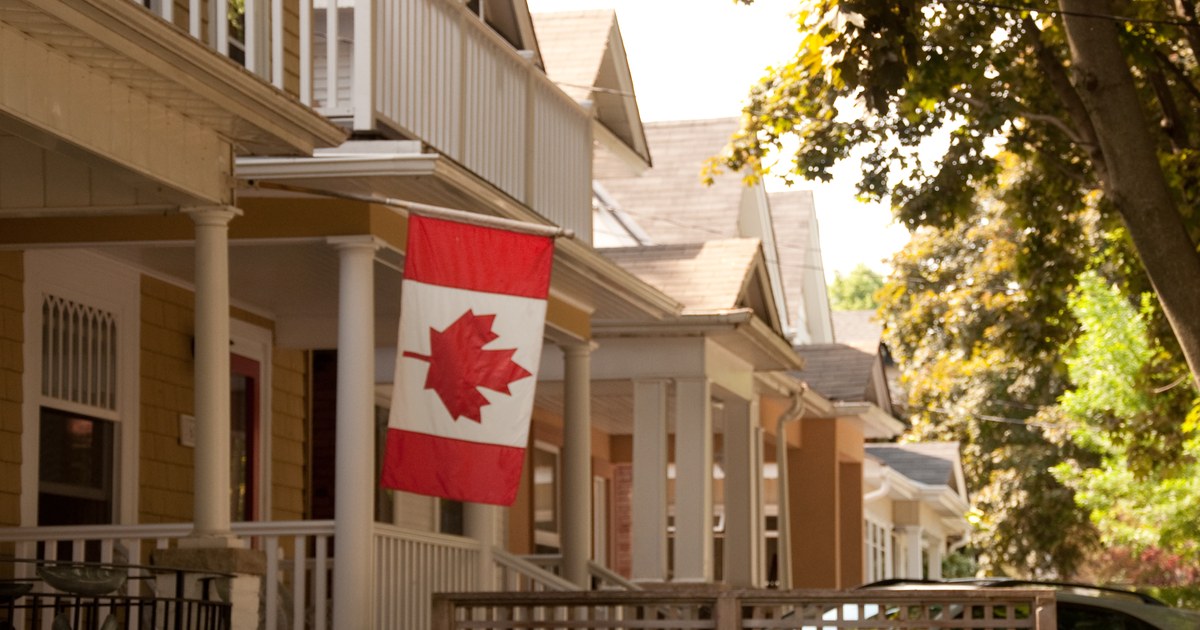
Featured photo: A Row of Houses in The Beaches, Toronto, by Josh Evnin via Flickr and Wikimedia Commons, licensed under CC BY-SA 2.0. Cropped. Mortgage rate figures are from Statistics Canada and the Bank of Canada. Renewal-wave figures are from the Bank of Canada's Staff Analytical Note 2025-21, July 2025. Rent figures are from Rentals.ca, October 2026. Vacancy figures are from CMHC's October 2025 Rental Market Survey.